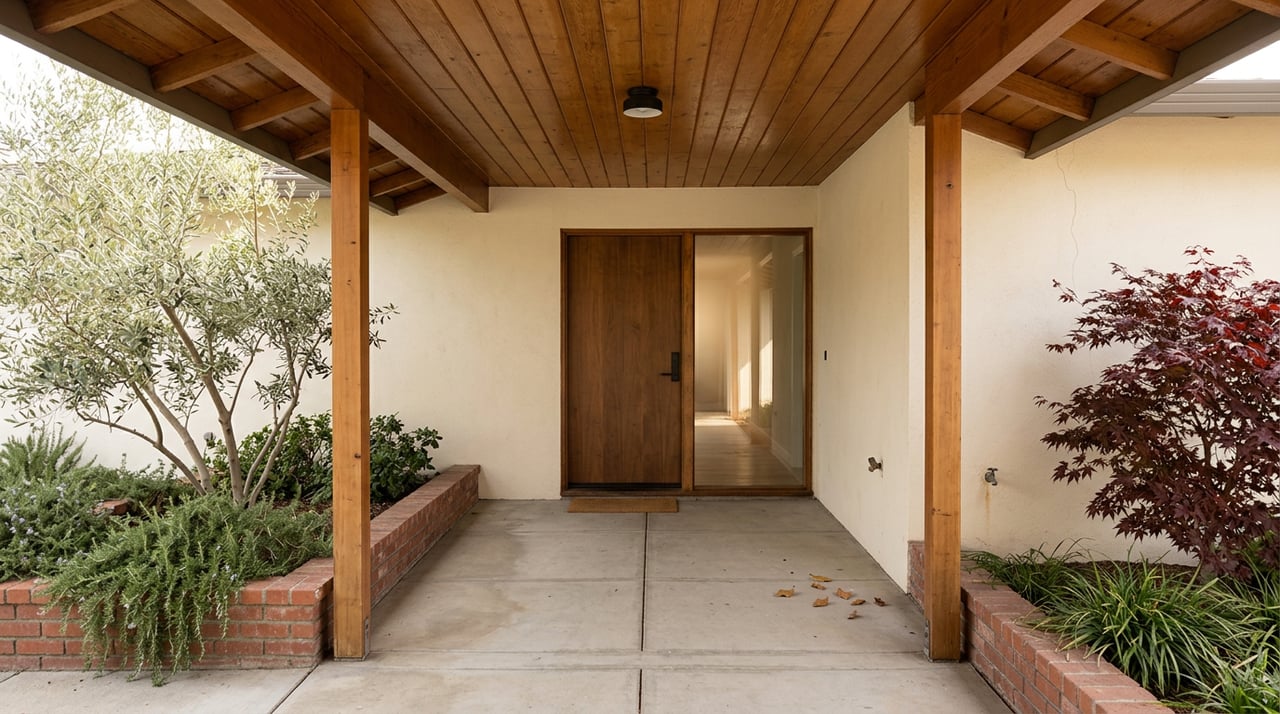
The Mountain View Eichler Premium Doesn't Cover What's Under the Slab
August 20, 2026
August 20, 2026
Ask around Mountain View and you'll hear the same reassurance about Eichlers: yes, they cost more, but that's the price of owning a piece of architectural history. Recent sales tracked by local specialists in 2026 put Eichler resales in Mountain View near $2.2 million, against a citywide single-family median of roughly $1.9 million over the three months ending in May 2026. A double A-frame in Bell Meadows on Eichler Drive listed for $3.35 million in mid-August 2026. Buyers read that premium as the whole story: pay more up front, own something rare.
It isn't the whole story. The premium buys you past the front door. What happens after that, when the radiant heat needs a pressure test or the garage panel gets flagged by an inspector, is where an Eichler starts behaving differently than every other home you've toured this year. The design that makes these houses desirable, the slab foundation, the absence of an attic or crawlspace, is the same design that makes ordinary repairs cost more and take longer. That's the number nobody prices into the offer, and it's the one worth understanding before you write one.
Mountain View holds two Eichler tracts, and they aren't interchangeable.
| Tract | Homes | Built | Architect | Streets |
|---|---|---|---|---|
| Fairview (Monta Loma) | about 200 | 1954 | Jones & Emmons | Quincy Drive, Benjamin Drive, Thaddeus Drive, Dell Avenue, Emmons Drive, Nedson Court, Victory Avenue, Richard Court, Alvin Street, Thompson Avenue |
| Bell Meadows | about 75 | 1972 to 1973 | Claude Oakland & Associates | Trophy Drive, Eichler Court, Eichler Drive |
The Monta Loma homes are smaller and earlier, mostly three-bedroom layouts under 1,400 square feet, sitting a short bike ride from Google's Shoreline campus. Bell Meadows came nearly two decades later under Claude Oakland, with larger four-bedroom models and, in some cases, enclosed atriums that read as bonus rooms rather than open courtyards. Buyers comparing the two are really comparing two different eras of the same idea, and the price gap between a compact Monta Loma original and a remodeled Bell Meadows four-bedroom reflects that as much as it reflects lot size or finishes.
That history matters for resale and for financing, but it doesn't change the mechanical reality both tracts share. Every one of these homes sits on a concrete slab. None of them has an attic you can walk into or a crawlspace you can send a plumber under. That single fact drives almost everything that follows in an inspection.
In a conventional ranch house, a bad electrical run or a plumbing leak means a contractor pulls back some drywall, fishes new wire through the attic or under the floor, and moves on. An Eichler doesn't offer that option. The wiring and radiant heat tubing were routed through the slab itself or through post-and-beam cavities designed to stay hidden, not to be reopened. When something needs replacing, there's no attic to hide the work and no crawlspace to route around the problem. The fix has to go through the slab, the roof, or an exposed beam, and each of those routes carries its own cost and its own risk of touching something original that a buyer wanted preserved in the first place.
This is the mechanism that turns a routine inspection finding into a bigger conversation than it would be in a 1985 tract home three blocks away. The finding itself might be ordinary. The path to fixing it is not.
Most Mountain View Eichlers still run on their original in-slab radiant heat, copper tubing looped through the concrete and fed by a boiler and pump. When it works, it's one of the more comfortable heating systems in any home in the city. When it leaks, the buried tubing can make locating the problem difficult.
The Eichler Network reports that "the water usually goes straight down into the ground," so a leak can run silently until a water bill spikes or a boiler starts cycling harder than it should. That's why a pressure test matters more here than in almost any other inspection category. A qualified radiant heat contractor will pressurize the system and watch whether it holds, typically for an inspection fee in the $150 to $300 range depending on the property. Anderson Radiant Heating, one of the specialty firms that services these systems across the Peninsula, has completed more than 5,700 hydronic radiant installations and repairs, and the guidance from professionals in this trade is consistent: get the system checked every one to three years, and don't assume a quiet floor means a healthy system.
Before you schedule that test, walk the house yourself and look for the early tells. Cold spots on the floor in winter. A water bill that climbed without an obvious reason. Damp or unusually warm patches on the slab near a bathroom or kitchen. None of these prove a leak, but any of them is reason enough to make the pressure test non-negotiable rather than optional.
Open the electrical panel in an older Mountain View Eichler and you may find a brand that inspectors and insurers treat very differently than a modern panel: Zinsco, or Federal Pacific Electric with its telltale thin red breaker stripe. Both were common through the decades these tracts were built, and both have documented histories of unreliable breaker behavior under fault conditions. That's not a cosmetic flag. Insurance carriers increasingly scrutinize original FPE equipment during underwriting, escrow review, and policy renewal, which means a panel that's been quietly working for fifty years can still complicate your ability to insure the house on the terms you expected.
It's worth correcting a common assumption here too. Not every Mountain View Eichler runs aluminum branch wiring, and the earlier Monta Loma homes generally used copper. Aluminum shows up more often in later construction phases and in remodel-era additions, so the presence of a panel from a certain decade doesn't automatically mean the wiring behind it is the higher-risk kind. An electrician familiar with Eichlers can help identify which situation you're in.
And because there's no attic or crawlspace to run new circuits through, even a straightforward panel upgrade in one of these homes often means opening slab or routing conduit over the roof, which is a very different scope and cost than the same upgrade in a conventional house down the street.
Because the slab is the foundation, the heating system, and in some cases the original flooring all at once, cracks in it deserve more attention here than in a typical inspection. Small hairline cracks are normal in concrete of this age and generally not a concern. What warrants a closer look is anything wider than about an eighth of an inch, or any crack where one side sits higher than the other, since that pattern can point to slab movement rather than simple curing shrinkage. Doors that drag, baseboards that have pulled away from the wall, or a garage slab with cracks radiating from a corner are all worth flagging for a structural opinion before you waive contingencies.
One more detail specific to homes of this vintage: original nine-inch by nine-inch vinyl floor tiles, if they're still present under carpet or newer flooring, were often installed with a mastic adhesive that can contain asbestos. It's not automatically a problem if left undisturbed, but it changes the calculus for any owner planning to refinish or replace flooring down the line.
None of this is a reason to avoid a Mountain View Eichler. It's a reason to structure your due diligence around what these homes actually are, rather than treating the inspection contingency as a formality once the architecture has already won you over. Before you write an offer, ask your agent to line up a radiant heat specialist and an electrician familiar with Eichler construction to supplement a general home inspection. Request the seller's service history on the boiler and pump if it exists. And budget your contingency conversations around the fact that any repair here may require opening a slab or routing over a roof rather than pulling back drywall.
The architecture is real and the premium is earned. The point is simply that the premium you pay at closing and the cost of ownership afterward are two different numbers, and only one of them shows up on the listing sheet.
Does a Zinsco or FPE panel mean I should walk away? Not automatically. It means budgeting for an electrician's evaluation and understanding that your insurer may require action before binding a policy. Many buyers negotiate a credit rather than a full replacement before close.
How do I know if the radiant heat is original before I schedule an inspection? Ask for any boiler or pump service records, and look for flooring that seems patched or replaced in small sections, which can indicate a prior slab repair.
Are Monta Loma and Bell Meadows homes priced the same? No. Bell Meadows homes are later, larger, and have reached up to $3.2 million in recent sales, while the smaller three-bedroom Monta Loma originals typically sit lower, reflecting their more compact footprint and earlier build era.
If you're weighing a Mountain View Eichler against other options on the Peninsula, or you already have one in mind and want a clear-eyed read on what an inspection will actually surface, Vicki Ferrando can walk the property with you before you write the offer. Request a complimentary market valuation and get a straight answer on what you're really buying.
This article is general information, not legal, tax or financial advice. Consult a qualified professional about your situation.
Stay up to date on the latest real estate trends.
Vicki is consistently the main point of contact throughout the real estate transaction and maintains a streamlined avenue of communication with clients. She curates a highly respected network of resources for connecting clients with local specialists and service vendors. Contact her today!
GET IN TOUCH WITH VICKI TO LEARN MORE

VICKI FERRANDO | CA DRE# 01418802
160 MAIN ST LOS ALTOS CA 94022